A 2.9-inch e-paper module that shows black, white, red and yellow — and keeps the image with the power off.
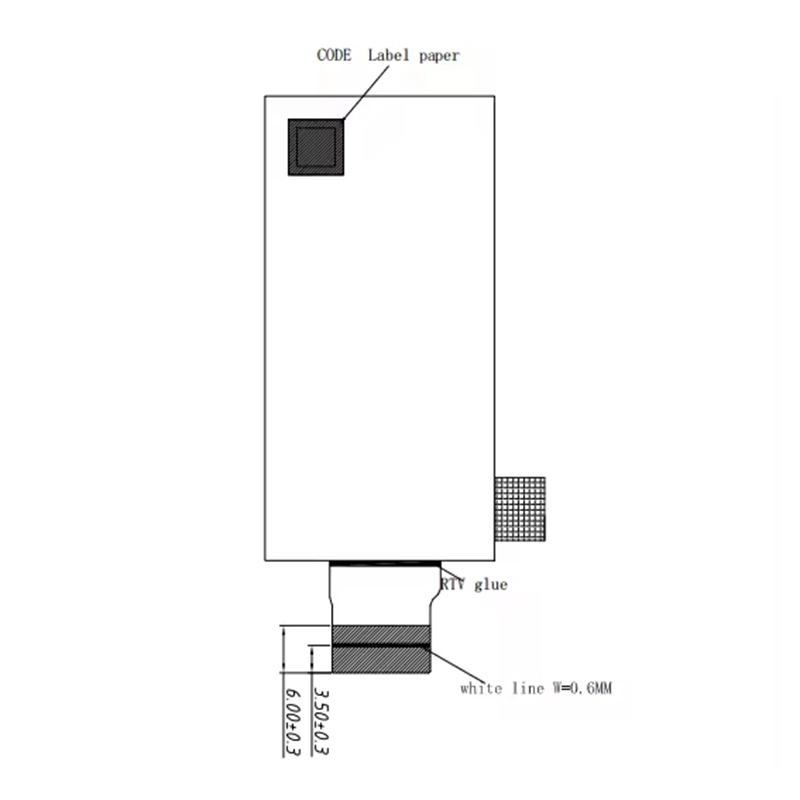
The Kingtech PV02901B0224B is a 2.9 inch 4-color e-paper display: 128×296 pixels at 112 dpi in a 36.70 × 79.00 × 0.93 mm module, driven over a 3-wire / 4-wire SPI interface through a 24-pin FPC. It is pure reflective with no backlight, bi-stable (the image stays without power), and draws 9.9 mW while updating and 0.003 mW in deep sleep.
Bi-stable and Paper-Like — the Power Budget Is the Point
E-paper's advantage is not that it draws little power while updating — it is that it draws almost nothing while doing nothing, and this module is specified to prove it:
Typical power (updating): 9.9 mW at VCI = 3.3 V
Deep sleep power: 0.003 mW — roughly 3 microwatts
Stand-by current: 1 ~ 5 µA
Typical operating current: ≤ 3.0 mA
Image update time: 25 sec at 25°C (full refresh)
Bi-stable display — once written, the pixels hold their state with the supply removed
For an ESL running a handful of refreshes a day, the refresh itself is a rounding error in the battery budget. That is why e-paper labels run for years on a single cell rather than weeks.
Typical applications: electronic shelf labels (ESL) in supermarkets and pharmacies, price and promotion tags, warehouse and logistics bin labels, industrial asset and equipment tags, meeting-room and smart-office signage, hospital bed/ward information labels, digital name plates.

 Get a Quote

 Documentation

Shelf-edge labels have one job: be read at a glance and stay correct for months on a coin cell. Most 2.9-inch e-paper modules do that in black and white only — which means a promotion has to be shouted with a bold font instead of a colour.
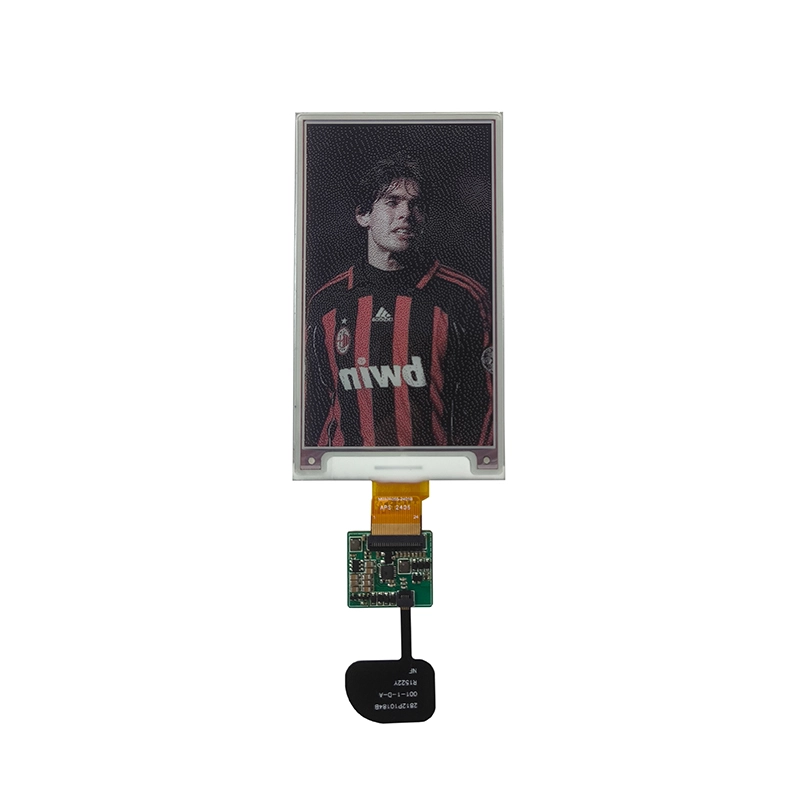
The PV02901B0224B is Kingtech's 2.9-inch 4-color e-paper display: 128×296 on a 29.06 × 66.90 mm active area at 112 dpi, with a Black / White / Red / Yellow output capability (2-bit, per spec §1). Red carries the price and the discount badge; yellow carries the attention cue; black and white keep the product name, unit weight and barcode crisp. All of it on a module just 0.93 mm thick.
4-color output — Black / White / Red / Yellow — red for price highlights and promotion tags, yellow for attention marks, over crisp black text and a clean white background. Not a monochrome-only panel.
Bi-stable: the image holds with zero power — typical updating power 9.9 mW, deep-sleep power 0.003 mW, standby current 1 ~ 5 µA. Sized for multi-year coin-cell and battery operation.
Pure reflective, sunlight-readable — no backlight, no glare washout; antiglare, hard-coated front surface. Readable under supermarket lighting and in daylight.
128×296 at 112 dpi on 2.9" — a standard ESL format (29.06 × 66.90 mm active area) that matches the installed base of shelf-edge rails and price-tag holders.
3-wire / 4-wire SPI, 24-pin FPC — one of the simplest display links on any MCU; low pin count, easy layout, low BOM cost.
Ultra-slim 0.93 mm / 5.40 ± 0.5 g — thin and light enough for clip-on and rail-mounted label housings.
0 ~ +40°C operating / -25 ~ +60°C storage — the actual spec-sheet rating; warm indoor retail and warehouse environments covered.
20+ years of display module manufacturing — in-house assembly, RoHS compliant, halogen-free, REACH declared.

There is no backlight. The module is pure reflective, so it uses the ambient light in the aisle instead of fighting it: brightness scales with the room, there is nothing to wash out under a skylight, and there is no backlight to dim with age. The front surface is antiglare and hard-coated, which keeps specular reflections and wipe-down wear under control on a shelf edge that gets touched.
Specified optical performance (spec §11.1, measured at 25°C with 45° illumination):
White state: L\ ≥ 59.5 (typ. 61)— a clean, bright background
Black state: L\≤ 12 (typ. 9), a\ ≤ 8— text with real contrast
Red state: a\ ≥ 38 (typ. 40), L\ ≥ 24, b\ ≤ 34 — the promotion colour reads as red, not pink
Yellow state: b\ ≥ 60 (typ. 66), L\ ≥ 54, a\ ≤ 18— the attention colour reads as yellow, not cream
Contrast ratio is defined in the datasheet as the ratio of full-white reflectance to dark reflectance (CR = R1 / Rd); the datasheet publishes the definition rather than a single guaranteed number, so we do not quote one.

The module speaks 3-wire or 4-wire SPI (spec §7), selected by the BS pin, with the usual SCL / SDA / CSB / DC / RST_N / BUSY_N control set brought out on a 24-pin FPC:
3-wire SPI — clock plus bidirectional data, the lowest pin count
4-wire SPI — clock, data-in, data-out and a DC (data/command) line
BUSY_N so your host knows exactly when refresh has completed — no blind delays
RST_N global reset; VDDIO 2.3 ~ 3.6 V and VDD 2.3 ~ 3.6 V logic rails
On-chip booster and regulator generate VGH / VGL / VCOM on-module — fewer external rails on your board
On-chip oscillator and OTP waveform storage — no external timing components, no waveform file to load at boot
I²C master interface available to read an external temperature sensor (TSCL / TSDA must be NC or pulled low if unused)
24 pins total: GDR, RESE, VSPL, VSH/VSP, VSN, VGP, VGN, VCOM, VDD_15V, VMTP and boundaries (full pin table in the datasheet)
SPI at this pin count drops onto almost any MCU without an LVDS/RGB front end, which is what keeps ESL tag BOM cost down.

1. Supermarket & convenience-store shelf-edge labels
Why it fits: 4-color output lets a promotion carry red price and yellow badge instead of relying on bold type alone; 128×296 at 2.9" is the standard rail format; and one update per day on a coin cell is exactly the duty cycle the panel is designed for.
2. Pharmacy & healthcare shelf labels
Why it fits: Legible drug name, dosage and price on the same small label; 4 colors separate prescription text from promotional marks; clean white background suits a clinical aisle.
3. Warehouse, logistics and bin labels
Why it fits: Bin codes, QR/barcode and quantity in black on white, with red or yellow for pick priority. Bi-stable output means the label survives a power or gateway outage without losing its content.
4. Industrial asset & equipment tags
Why it fits: Equipment number, asset code and QR in a 0.93 mm, 5.4 g module that clips onto a machine or a rack. Deep-sleep draw of 0.003 mW suits always-on tagging with no wiring.
5. Smart office, meeting-room and hospital information plates
Why it fits: Name plates, room status and ward information that can be rewritten centrally and then left unpowered; paper-like readability in normal interior light.

Parameter | Specification |
Model No. | PV02901B0224B |
Screen Size | 2.9 inch |
Display Type | Active Matrix Electrophoretic Display (AMEPD) |
Resolution | 128 (H) × 296 (V) pixels |
Pixel Density | 112 dpi |
Display Colors | Black / White / Red / Yellow (2-bit, B/W/Y/R) |
Pixel Configuration | Rectangle |
Weight | 5.40 ± 0.5 g |
Interface | 3-wire / 4-wire SPI (MCU serial peripheral interface) |
Interface Selection | BS pin (3-wire / 4-wire); DC pin for data/command |
Control Pins | CSB, SCL, SDA, DC, RST_N (global reset), BUSY_N (driver status) |
Connector | 24-pin FPC |
Package | COG (chip on glass) |
On-chip Supply Generation | Booster + regulator for VCOM, gate and source driving voltages |
Display Mode | Pure reflective, no backlight; bi-stable |
Operating Temperature | 0 ~ +40°C |
Storage Temperature | -25 ~ +60°C |
Optimal Storage Condition | 23 ± 2°C, 55 ± 10% RH |
Reliability | -25°C storage 240 h; +60°C/35% RH storage 240 h; +40°C/35% RH operation 240 h; 0°C operation 240 h; +40°C/80% RH operation 240 h; +60°C/80% RH storage 240 h; thermal cycling -25°C↔+60°C × 100 cycles; UV 765 W/m² × 168 h @40°C; ESD gun air ±4 kV / contact ±2 kV |
Inspection Standard | GB/T 2828.1-2012, level II — CR AC/Re = 0/1, MA = 0.4, MI = 1.0 |
Compliance | RoHS; halogen-free; REACH declared (per drawing notes) |
Operating / storage temperature — 0 ~ +40°C operating and -25 ~ +60°C storage are the values in the specification's absolute maximum rating table (§9). Do not upgrade them to a "wide temperature" claim.

Industry | Use Case |
Retail / Supermarket | Shelf-edge price and promotion labels — red for price, yellow for the discount badge, black/white for name, weight and barcode |
Pharmacy / Healthcare | Drugstore shelf labels with legible name, dosage, price and barcode on one label; clean clinical white background |
Warehouse / Logistics | Bin and storage location labels (code, QR, quantity); content survives power loss because the display is bi-stable |
Industrial / Smart Factory | Equipment and asset tags, work-order and line-status cards that can be rewritten centrally and then left unpowered |
Smart office / Facilities | Meeting-room plates, desk name plates, ward and room information displays in normal interior lighting |

Founded in 2003, Kingtech is a professional provider of customized LCD module solutions, covering TFT, E-paper, AMOLED from 0.91" to 28.6". Over 90% of our products are custom-developed for industrial equipment, medical devices, POS systems and outdoor applications.
20+ years of LCD supply chain expertise
IATF16949 / ISO 13485 certified quality systems
99% production yield
BOE authorized channel with full engineering support
Professional engineering team for customization

A: 4-color. The module is specified as 2-bit Black / White / Red / Yellow. That means a promotion label can carry a red price and a yellow attention badge while the product name, weight and barcode stay crisp black on white.
A: 128 × 296 pixels at 112 dpi, on an active area of 29.06 × 66.90 mm — the standard portrait format for 2.9-inch shelf-edge labels. The module itself measures 36.70 × 79.00 × 0.93 mm and weighs 5.40 ± 0.5 g.
A: 9.9 mW typical while updating (VCI = 3.3 V), 0.003 mW in deep sleep, 1 ~ 5 µA stand-by current, and ≤ 3.0 mA typical operating current. Because the display is bi-stable, the image stays on screen with the supply removed — which is what makes multi-year coin-cell operation practical.
A: 25 seconds at 25°C for a full refresh. That is normal for this class of 4-color e-paper and is why e-paper labels refresh on a schedule rather than in real time. Send us your refresh-frequency requirement and we will help you size the battery budget.
A: No backlight — it is pure reflective. Readability comes from ambient light, so it stays clear under store lighting and in daylight, with no glare washout and no backlight to fade. The front surface is antiglare and hard-coated.
A: 3-wire or 4-wire SPI, selected with the BS pin, on a 24-pin FPC. The control set — SCL, SDA, CSB, DC, RST_N and BUSY_N — is what an ordinary MCU needs; there is no LVDS or RGB front end. On-chip booster, regulator, oscillator and OTP waveform storage mean fewer external components, and the I²C master can read an external temperature sensor.
A: 0 ~ +40°C operating and -25 ~ +60°C storage, with an optimal storage condition of 23 ± 2°C / 55 ± 10% RH. This is the specification's rating — it suits indoor retail, pharmacy and warehouse environments — and the same 0 ~ 40°C rating is published in the attribute table of our Alibaba.com listing for PV02901B0224B. Freezer rooms and outdoor installations are outside the standard rating and need an engineering review.
A: The specification is written around one update per day, and it states that pixel display quality is not guaranteed for 5 years where humidity is below 45% RH or above 70% RH. If your deployment refreshes many times per hour, or runs in a very dry or very humid room, tell us up front — that is a project review, not a standard application.
A: Yes. The panel supports Black & White, Black / White / Red, Black / White / Yellow and full Black / White / Red / Yellow content. The colour set is defined by the waveform and the content you send.
A: Yes. We support logo printing, UI/template design for the 128×296 canvas, custom FPC (length, shape, bend, pin definition) and structure (cover lens, frame, mounting), plus interface adaptation and display-driver integration support, through a five-step process: requirement communication → solution proposal → design & sample → testing & validation → mass production.
Tell us your label format, refresh frequency and expected battery life — we will confirm the display fits before you commit, and flag anything that needs a project review (humidity extremes, low-temperature storage, high refresh rates). With 20 years of display module experience and a full e-paper portfolio from 1.54" to 13.3", Kingtech can cover your whole shelf line from one supplier. We respond within 24hours.


 English
 日本語
 français
 Deutsch
 Español
 italiano
 русский
 português
 čeština
 Suomi
 Polska
 Svenska